
EV Charging Prices by State, Network & Charger Type in 2026
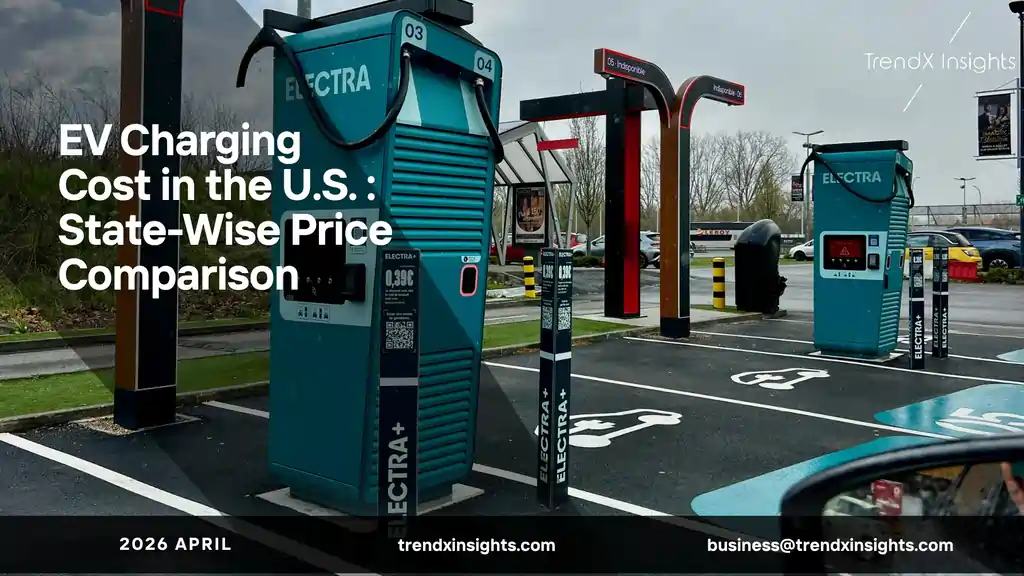
Primary data is drawn from published rate schedules of eight major U.S. public EV charging networks: Tesla Supercharger, Electrify America, ChargePoint, EVgo, Blink Charging, Shell Recharge, FLO, and EV Connect. Data covers member and non-member pricing across Level 2 (AC), DC Fast, and Ultra-Fast charger categories for all 50 U.S. states and D.C. TrendX Insights cross-referenced pricing data against network operator websites, utility rate filings, and third-party benchmarking sources as of Q1–Q2 2026. All figures are in USD. Cost per 100 miles assumes 3.0 miles/kWh (EPA mid-size BEV average). Rates subject to change without notice.
Quick Answer: How Much Does It Cost to Charge an EV Publicly in 2026?
EV charging prices by state in 2026 vary significantly by charger type, network, access tier, and location. Current rate ranges across the eight major U.S. networks covered in this report:
- Level 2 (AC): $0.20–$0.42/kWh non-member | $0.17–$0.34/kWh with membership. Adds 20–40 miles of range per hour.
- DC Fast Charging (50–150 kW): $0.22–$0.68/kWh (or per minute) non-member | $0.18–$0.51 with membership. Adds 150–400 miles per hour.
- Ultra-Fast (150–350 kW): $0.36–$0.85/kWh non-member | $0.26–$0.64 with membership. Adds 400–800+ miles per hour.
Cost per 100 miles ranges from $5.67 (FLO Level 2 member, standard-rate state) to $28.33 (Electrify America Ultra-Fast, non-member, high-cost states). Membership plans reduce per-session cost by 20–30% on average.
Why EV Charging Prices Vary So Dramatically Across the United States
Unlike gasoline, where pump prices are posted and updated by the hour, public EV charging rates vary across dozens of network operators, multiple charger tiers, competing pricing models, and fifty states—each with different electricity costs, utility regulations, and per-kWh billing laws. A ChargePoint member at a workplace Level 2 port in Georgia pays less per session than a non-member using an EVgo DC fast charger on a highway corridor in Colorado. The spread is real and consequential for both drivers and fleet operators.
This report compiles pricing data for eight major U.S. public EV charging networks across all 50 states, three charger types, and two access tiers (member and non-member). The goal is to give EV drivers, fleet operators, and infrastructure investors a single, comparable, evidence-based reference for what public charging costs in 2026—and why those costs differ by location and network.
How This Pricing Data Was Compiled
All pricing figures are sourced directly from each network operator’s published rate schedules, app-based pricing displays, and official membership program disclosures as of Q1–Q2 2026. Where networks use dynamic or location-variable pricing—as ChargePoint, EVgo, and Blink do—ranges reflect documented low and high rates observed across active U.S. station locations. Where networks operate flat national rates, as Tesla’s Supercharger membership tier does, those rates are applied uniformly, with adjustments noted for states where Tesla discloses higher regional pricing (Alaska, Hawaii, California, Colorado, Connecticut).
For networks using per-minute pricing (EVgo in most states), cost per kWh equivalents are estimated based on published session data assuming a 50 kW average delivery rate for DC Fast sessions and 150 kW for Ultra-Fast sessions. These are approximations; actual cost per mile will vary based on vehicle efficiency, battery state of charge, ambient temperature, and charger output at the time of session.
EV Charging Networks Compared: Tesla, Electrify America, ChargePoint, EVgo & More
This report covers the eight largest or most operationally significant public EV charging networks currently active in the United States as of 2026. Each network has a distinct pricing structure, geographic footprint, and membership model.
Largest U.S. DCFC network by port count. Open to all EVs via NACS connector or adapter. Non-Tesla drivers pay $12.99/month for ~$0.10/kWh discount. Flat national rate with higher pricing in Alaska, Hawaii, California, Colorado, and Connecticut.
Largest non-Tesla DCFC network. Uses station-specific dynamic pricing. Pass+ membership ($7/month) provides ~25% discount across all tiers. Labels 150 kW as “Ultra-Fast” and 350 kW as “Hyper-Fast.”
Largest Level 2 network by port count. Uses host-set pricing: individual site operators determine the rate. No national membership; drivers pay host-set rates at point of session.
Public DCFC network; charges per minute in most states, per kWh in California. Membership provides discount on per-minute rate. Per-minute pricing creates cost ambiguity for drivers with low-acceptance-rate vehicles.
Mixed Level 2 and DCFC network. Per-kWh pricing and membership plans (Blink+) available. Rates vary by location but follow published national tier guidelines.
Shell-branded stations only; limited U.S. metro footprint. Shell exited third-party charging software management in April 2025, limiting operational data availability. Membership discount available.
Primarily Canadian network with U.S. presence strongest in New York, California, Oregon, and the Pacific Northwest. Lowest published per-kWh rates of any network in this report. Limited availability in most U.S. states.
Schneider Electric subsidiary. Host-set pricing model similar to ChargePoint. Available at select commercial and institutional locations. No membership tier; non-member pricing only.
How EV Charging Pricing Models Work
Understanding what a driver pays comes down to three key variables: the pricing unit, the access tier, and the charger type.
Per kWh vs. Per Minute: Why It Matters for Your Bill
Per-kWh pricing is the most transparent model, directly reflecting energy delivered and allowing straightforward cost-per-mile calculation. Per-minute pricing, used by EVgo in most states, introduces variability: a slower-charging vehicle pays more per kWh than a vehicle accepting charge at the full rated speed. At an EVgo DC Fast station at $0.35/min, a vehicle accepting 50 kW incurs an effective per-kWh rate of approximately $0.42/kWh—double what a faster vehicle accepting 100 kW pays ($0.21/kWh equivalent).
Member vs. Non-Member Access Tiers
Every major network operates at least two pricing tiers: a standard non-member rate and a discounted member rate. Membership discounts range from approximately 20% at Blink and Shell Recharge to 25% at Electrify America Pass+. Tesla’s non-Tesla driver membership ($12.99/month) provides roughly $0.10/kWh in savings. For frequent public charger users, membership payback periods are typically four to eight weeks depending on usage volume.
Level 2, DC Fast, and Ultra-Fast: The Three Charger Tiers
Level 2 AC chargers operate on 208–240V circuits and deliver 3–19 kW, adding 20–40 miles per hour. DC Fast Chargers (50–150 kW) deliver high-voltage DC directly to the battery, adding 150–400 miles per hour. Ultra-fast chargers (150–350 kW) represent the premium tier; Electrify America’s Hyper-Fast 350 kW stations carry the highest rates documented in this dataset. For a full cost, speed, and site-selection comparison of these charger types, see our Level 2 vs DC Fast Charger guide.
State-by-State EV Charging Price Comparison (Interactive Table)
The interactive table below presents the full pricing dataset for all eight networks, three charger types, and two access tiers across all 50 U.S. states and D.C. Use the filters to narrow by network, charger type, or membership status. Data source: TrendX Insights / Network Operator Disclosures, Q1–Q2 2026.
| State | Network | Type | Access | Rate | Model |
|---|---|---|---|---|---|
| Generating dataset… | |||||
* EVgo per-minute rate converted to $/kWh equivalent assuming 50 kW average DC Fast session delivery.
Key EV Charging Price Insights: What the 2026 Data Reveals
The Cheapest and Most Expensive Networks Are 3–5× Apart
FLO and ChargePoint represent the low end, with Level 2 non-member rates as low as $0.20–$0.22/kWh in standard-rate states. Electrify America Ultra-Fast (350 kW) non-member rates reach $0.85/kWh in high-cost states—a 3–5× spread. For a driver adding 30 kWh per session, the total ranges from $6.60 to $25.50.
Alaska and Hawaii Consistently Charge Higher Rates Across Every Network
Every network charges higher rates in Alaska and Hawaii, reflecting higher baseline commercial electricity costs. Electrify America DC Fast non-member rates in high-cost states reach $0.68/kWh, significantly above the standard-state rate of $0.43/kWh. Tesla Supercharger non-member rates in high-cost states run $0.50–$0.58/kWh versus $0.31–$0.36/kWh in standard-rate states.
Memberships Deliver Consistent 20–30% Savings Across All Networks
Every network offering a membership plan delivers a consistent 20–30% reduction in per-kWh or per-minute rates. The highest-value memberships in terms of proportional discount are FLO (25–30% reduction) and Electrify America Pass+ (25% flat discount across all tiers and states).
Per-Minute Pricing: Why Slower-Charging Vehicles Pay More Per kWh
EVgo uses per-minute pricing in all states except California. Drivers whose vehicles accept DC fast charge at 50 kW or below pay more per kWh equivalent than drivers in vehicles accepting full charger output. Drivers should check their vehicle’s typical DC fast charge acceptance rate before selecting a per-minute network for regular use.
Shell Recharge’s 2025 Software Exit
Shell Recharge exited third-party charging software management in April 2025, limiting real-time rate visibility and reducing network reliability data for this report. Drivers relying on Shell Recharge stations should verify current rates and availability directly with Shell before planning charging stops.
FLO’s Low Rates: Available Only in Select U.S. Markets
FLO consistently posts the lowest per-kWh rates in this dataset—as low as $0.17/kWh for Level 2 member pricing in standard-rate states. However, FLO’s U.S. presence is heavily concentrated in New York, California, Oregon, and the Pacific Northwest. For drivers in FLO-strong markets, membership is among the highest-value options in the dataset.
Membership vs. Non-Member Pricing: Is a Charging Membership Worth It?
Across all eight networks, paid membership plans reduce per-session costs by 20–30%. The financial case for membership depends on one variable: how frequently a driver uses that network’s public charging infrastructure.
The Tesla Supercharger non-Tesla membership at $12.99/month saves approximately $0.10/kWh across all Supercharger sessions – a driver adding 40 kWh per public session recoups the monthly cost in roughly three sessions. Electrify America’s Pass+ at $7/month delivers a 25% discount; a single 30 kWh DC fast session at $0.55/kWh ($16.50 total) versus $0.41/kWh ($12.30 total) saves $4.20 – recovering the monthly fee in fewer than two sessions.
For drivers using public fast charging more than four to six times per month, the financial case for membership is clear. For infrequent users who charge primarily at home or workplace Level 2 installations, payback extends to two or three months.
Cheapest EV Charging Network by Charger Type in 2026
Level 2 (AC): FLO and ChargePoint
FLO member pricing ($0.17–$0.25/kWh) and ChargePoint non-member pricing ($0.22–$0.40/kWh) represent the lowest end of the Level 2 pricing spectrum in standard-rate states. FLO’s advantage is available only in its U.S. coverage markets. ChargePoint’s host-set pricing model means individual locations may fall above or below the typical range.
DC Fast Charging: Tesla Supercharger (Member)
Tesla Supercharger member pricing for non-Tesla drivers ($0.21–$0.48/kWh across standard to high-rate states) is the lowest consistently available DC fast charging rate in this dataset, accessible at more locations than any other DCFC network in the U.S. For non-Tesla EV owners with NACS-compatible vehicles or adapters, the $12.99/month subscription is the most cost-effective approach to regular public DC fast charging in most states.
Ultra-Fast (150–350 kW): Tesla Supercharger (Member)
At the ultra-fast tier, Tesla Supercharger leads on price. Electrify America’s 350 kW Hyper-Fast tier ($0.55–$0.85/kWh non-member) is the most expensive ultra-fast option in the dataset even with Pass+ membership in high-cost states.
Why EV Charging Costs Differ by State: Electricity Rates, Utility Rules & Demand Charges
State-level variation reflects four main factors: underlying commercial electricity costs, state utility regulations governing per-kWh billing by non-utilities, network operator cost recovery strategies, and demand charges imposed by local utilities on high-power commercial accounts.
Electricity cost is the most direct driver. According to U.S. EIA retail electricity data, states with higher commercial retail electricity rates (Hawaii, Alaska, Connecticut, California, Colorado) consistently produce higher EV charging rates across every network. States with lower commercial electricity costs – notably the Southeast and parts of the Midwest – produce the lower end of each network’s pricing range.
Demand charges – utility fees based on a commercial customer’s peak 15-minute power draw – are a significant factor for DCFC and ultra-fast stations. Networks with the highest ultra-fast rates (Electrify America) face the highest demand charge exposure, and that cost is ultimately passed through to drivers. For a full breakdown of what EV charging stations cost to build and operate, see our EV Charging Station Cost in 2026 report.
Frequently Asked Questions: EV Charging Prices by State 2026
Public EV charging rates range from $0.17/kWh (FLO Level 2 member) to $0.85/kWh (Electrify America Ultra-Fast non-member, high-cost states). A typical non-member DC fast session of 30–40 kWh costs $12–$26 depending on the network and state.
FLO has the lowest rates ($0.17–$0.28/kWh member) but is available mainly in New York, California, Oregon, and Washington. Among nationally accessible networks, Tesla Supercharger member pricing ($0.22–$0.43/kWh) is the most cost-effective option for DC fast charging in most states.
Yes, in most states. Electrify America non-member rates ($0.43–$0.85/kWh) are higher than Tesla Supercharger rates for the same charger type and state. Tesla member pricing ($12.99/month) undercuts Electrify America Pass+ ($7/month) at DC Fast and Ultra-Fast tiers in most states.
EVgo uses per-minute pricing in most states due to state utility regulations that historically restricted per-kWh billing by non-utility entities. California is the exception. Drivers whose vehicles accept charge slowly pay more per kWh equivalent under per-minute models.
Paid membership plans reduce per-session costs by 20–30% across major networks. Electrify America Pass+ ($7/month) gives a flat 25% discount; Tesla’s non-Tesla membership ($12.99/month) saves ~$0.10/kWh. For drivers charging publicly four or more times per month, payback typically occurs within two to four sessions.
Alaska and Hawaii have the highest commercial electricity costs in the U.S., driven by geographic isolation and limited grid interconnection. These higher input costs flow through directly to EV charging rates across every network, and high-power stations in both states face elevated utility demand charges.
At per-kWh networks (Tesla, Electrify America, Blink, FLO, ChargePoint, Shell Recharge), the rate is the same regardless of vehicle; only session duration varies. At per-minute networks like EVgo, slower-charging vehicles pay more per kWh equivalent—a vehicle accepting 50 kW pays roughly double the effective rate of one accepting 100 kW.
Shell Recharge stations remain operational in select U.S. metro markets. Shell exited third-party charging software management in April 2025, affecting real-time rate visibility and station reliability. Verify current rates and status directly with Shell before planning a charging stop.
Using 3.0 mi/kWh (EPA mid-size BEV average), DC fast charging costs range from approximately $6.00/100 miles for FLO members in standard-rate states to $28.33/100 miles for Electrify America non-members in high-cost states. See the full dataset in the interactive table above.
States in the Southeast (Alabama, Arkansas, Georgia, Florida) and parts of the Midwest have the lowest public EV charging rates, with Level 2 non-member pricing as low as $0.20–$0.22/kWh at ChargePoint and FLO locations. Alaska, Hawaii, California, Colorado, and Connecticut consistently rank among the highest-cost states.
- Tesla Supercharger pricing: Tesla.com/supercharger
- Electrify America pricing & Pass+: ElectrifyAmerica.com
- ChargePoint pricing: ChargePoint.com
- EVgo pricing: EVgo.com/pricing
- Blink Charging pricing: BlinkCharging.com
- Shell Recharge pricing: Shell.com/recharge (rates as of Q1 2026; third-party software exit April 2025)
- FLO Network pricing: FLO.com
- EV Connect pricing: EVConnect.com
- U.S. EIA — Average Retail Price of Electricity by State (2024–2025): eia.gov
- NREL — EV Charging Station Reliability: docs.nrel.gov/fy24osti/89896.pdf
- DOE AFDC — EV Charging Infrastructure Trends Q2 2024: afdc.energy.gov
- IEA — Global EV Outlook 2025: iea.org/reports/global-ev-outlook-2025
TrendX Insights is an independent research publisher. This report does not constitute financial, investment, or operational advice. Pricing data reflects published network rate schedules as of Q1–Q2 2026 and is subject to change without notice. TrendX Insights has no commercial relationship with any network operator referenced in this report.
Found a data point that has changed? Spotted an error in our figures? Have a topic you would like TrendX Insights to cover next? Drop your thoughts below:
Your email, if given, is never published or shared.